IT STARTED ON SAWYER

Adventures in Sustainable Renovations


Leave a comment

Week 42 – Flurry of Construction!

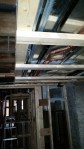
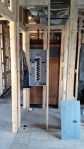
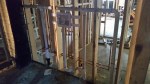
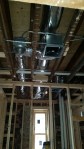
This week has seen an exceptional amount of work done, mostly due to the number of various trades coming on site everyday. Our HVAC contractor was on site this week to drill through exterior wall to route the exhaust fan ducts from the basement bathrooms to the exterior. Our Electrical contractor kept plugging away at roughing in the electrical and he was able to install the recessed can lights in our first floor dinning room (we have kept the ceiling because we are afraid that demo would damage the original wood beams). Our plumbing contractor roughed-in the gas piping. Due to space restrictions, we will end of with a larger bulk head in the north side of the basement, but to minimize this bulk head, the ducts, conduit, gas and water piping are packed as close together as possible. Our plumber also installed the bathtub in the second floor master-bath and the bathtub in the basement hall bath (this one was a nice donation by our family general contractor from a project that decided not to use it). Finally, our plumber installed the thermo mixing-valve for our bathrooms.

in the front of the building, the basement front bay side windows have window wells originally required as emergency egress. These window wells have drains built into them, which we knew have been clogged and will at minimum need cleaned out. This week, we brought a specialized plumber to scope our main drainage and sewer lines. With a few unique tools and a camera, the contractor marked the depth of the sewer line as well as the location of the main connections between the window well drain lines to the house main sewer line. Through the camera, we can see that at minimum, we will need to replace the drain pipe elbows. The main sewer line runs directly underneath the 50 foot tree that grows in front of the building and it has roots that have penetrated the pipe. Once we replace the drain piping, we will have access to the sewer line from the front of the building and we will send a roto-rooter through to clean out the main line.

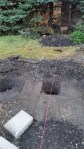
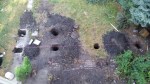
In addition to our MEP contractors, we had our concrete contractor dig foundation holes in the backyard for the future supports for the back stairwell and deck. He placed a central line to keep an equal distance from the building (9 feet) and he dug out the holes for the foundation supports keeping equal distance between the eventual columns.

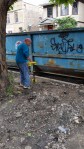
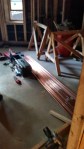
On the back addition, we also had our siding contractor start work this week. We choose to go with HardiePlank, which is a high quality cement board siding that should give us minimal maintenance and a strong longevity. The product is a little more difficult to install then a vinyl siding, but we have been very pleased with the contractor we have found. We set up his work area in the backyard to measure out and cut the exact dimensions of the pieces he needs. Then he mounted each piece making sure its level and overlaps the piece beneath it.

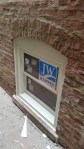
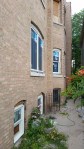
Meanwhile, we are also gearing up to start insulation on the interior of the building. In order for us to start, we need to be sure that the building is completed sealed from the outside. Our biggest remaining air gaps have been the framing surrounding the windows. To complete the exterior, we found a contractor to installed the window flashing and caulk any remaining openings from the exterior of the building. The flashing covers up the visible plywood and adds a nice final look to the windows. Once the contractor began to complete a few windows, the flashing really helped make some of the original brick arches become more defined.

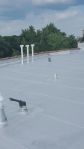
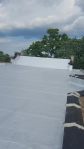
Finally, with our MEP contractors having finished all of their stub outs through the roof, we had our roofing contractor come back and finish our back-roof. This work included properly sealing all of the vent stub outs, adhering the roofing to the firewall, and painting the roof a reflective color to minimize heat gain and reduce the heat island effect. (For more information, please see http://www2.epa.gov/heat-islands/using-cool-roofs-reduce-heat-islands ). A green roof would have been the ideal, but we are quickly running out of funds for this project and a green roof would be too cost prohibitive.

All said, we had over 20 different people working on the building this week! Its great to see such progress and here’s to keeping up the momentum!


Leave a comment

Week 41 – MEP continued

With the building enclosed and the security system installed, our contractors begin installing the more vulnerable components of their system. Our plumber has delivered the copper piping and over the course of the last week piped the majority of the domestic water system.

Our electrical contractor has brought over the heavy duty main electrical wiring, the electrical meter housing, the main power disconnects, fuse boxes, and bathroom exhaust fans. Over the course of the week, the main conduit piping has been installed on the exterior of the building and has been connected to the meter housing and building disconnects. The bathroom exhaust fans have been installed on the second floor and the 1st and 2nd floor as well as the public area electrical fuse boxes have been installed. Unfortunately, due to a max distance requirement from the main power cut out to our fuse box, we have ended up with fuses in one of our basement bedrooms as well as one in a 2nd floor bedroom. This is not ideal and we’ll have to incorporate this into the final look as best as possible. With the fuse boxes in place, this allows our electrician to start running the conduit from around the apartment back to the main power source.

Finally, our HVAC contractor kept plugging away at installing duct work and PVC exhaust flues. The biggest accomplishment of the week was running the 3 exhaust flues (future furnace, and 2 water heaters) from the basement mechanical room up through the building and out through the roof. We have asked all of our contractors to complete their roof stub-outs as soon as possible so that we can finish our roof installation.


Leave a comment

Weeks 39 & 40 – Windows bring problems

Construction sites are typically a target for theft and crime and our site is no different. To start the week, we found that someone had broken in and stolen our sump pump and ejector pump. They cut through the PVC piping and pulled the pumps out of the basins. Luckily, this is not terribly expensive and there was no other damage to the building, but this is certainly a wake up call. Speaking with our contractors, we learned that once burglars see windows going in on a construction site, they start to expect copper piping and other valuable materials to be on site. With that info, Andrea and I ordered a security system / service and installed window and door sensors, motion sensors, and a loud alarm in the building to help try to prevent future issues.

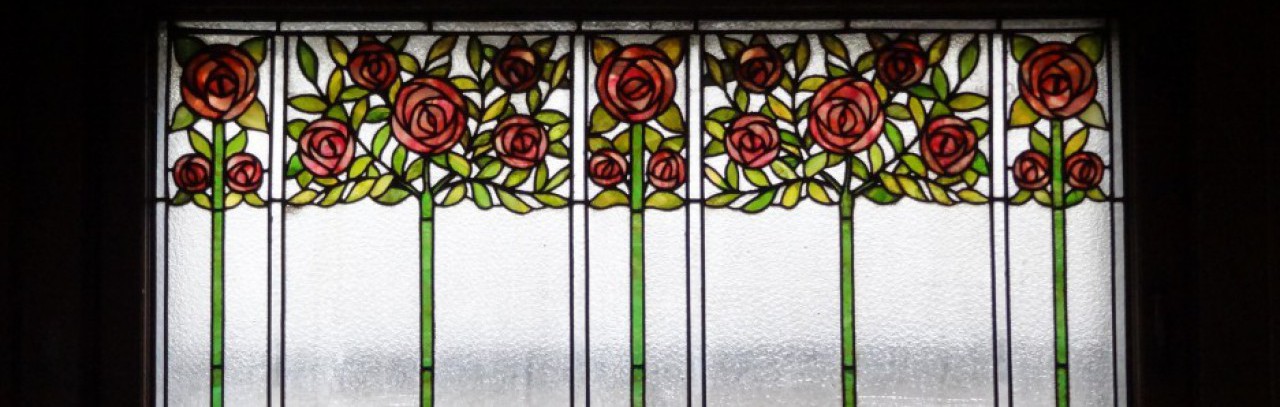
On a happier note, our MEP contractors continued with their work on all levels of the building. The plumber completed his PVC piping runs, the mechanical contractor started with the duct runs in the basement, and the electrician ran conduit on the first floor. The window installation has also continued, including the installation of a horizontal window in the back addition which we will eventually use to install two restored stained glass windows. We also found that the basement front bay openings were just slightly too small for the windows we ordered. It turned out that the limestone lintels were a little bigger than expected. Our masonry contractor trimmed the middle bay, while our carpenter re-framed the two side windows and we got the windows installed. Finally, our carpenter framed out the location of the 2nd floor kitchen island. Our intention is to install cabinets in the first floor island and build out shelving for the 2nd floor island.


1 Comment

Week 38 – Windows!

Windows have arrived on site!! This is actually the culmination of a process that started some eight weeks prior to this week. We met several times with our window rep from Schaaf Windows to get the order details done correctly. The rough carpentry window openings had to be complete to get an accurate measure for the window sizes. Once the opening were complete, our rep came up to verify every window size and create the window schedule for the order (over 43 windows in the building). We also used old photos of the building to replicate the old grids in the front windows and bring back the historical look of the property. With our future plans to restore the old stained glass windows, we order picture windows sized so that the stained glass windows can fit tightly within the window frame. This will protect the stained glass from the outside, while still allowing all of the natural light to bring out the great detail of the windows. Finally, to try to keep the building more energy efficient, we went with double pane, low-e, argon filled windows. (The low-e coating on the window greatly affects the window’s energy emissivity and will allow a significant portion of the solar energy to be reflected back away from the building. The effect of this coating is calculated into the window’s U-value. The argon fill is less heat conductive than air, therefore improving the U-value of the window.) Once we had finalized and placed that actual order, there was about a six week lead time for the windows to be manufactured and delivered to site. Over the course of the week, our carpentry crew began installing the windows throughout the building. Its amazing to see what a big difference this make to the look and feel of the building.

With the window installation going in, we also gave the go ahead to both our electrical and plumbing contractor to begin their interior work. The electrician came in first to install the can lighting in the basement and other potential conflict areas. The order of work is important, especially in our basement, because we can’t fit plumbing pipes and can lighting between the same floor joist and you would much rather have the correct lighting spacing since this ultimately impacts the final look of the finished space. With the can lighting in place, our plumber started with the PVC piping runs (we’ll want to make sure the property is very secure before copper comes on site). Our plumber started by connecting to the previously installed sump pump and ejector pump basins and ran the pipe above street level before coming back down (our over head sewer as mentioned in week 26). With the main sewer lines connected, our plumber has gone on to install the main drains in our plumbing wall running up from the basement to the second floor.

Plenty of great work done this week! Can’t wait to see what the next week will bring!