
To start the week off, we had our construction crew come through and remove up to 6 inches of soil from our basement to make the basement floor level and to make sure we have adequate ceiling height. Ceiling height in a basement must be a minimum of 7’6″ per the City Code to be considered a legal living space, but anything under 8″ starts to feel cramped. We asked our contractors to dig out enough dirt to account for the future insulation, concrete slab, and ceiling drywall and leave us with a minimum of 8 feet ceiling heights.
With the dirt removed, our plumbing contractor showed up on site to install the underground plumbing. The contractor first dug out two deep holes in the south corner of the basement and installed the catch basin, where at a later date we’ll install the sump pump, for the drain tile system (see week 22). The second hole, the plumber placed the basin for the sewage ejector system. To prevent any back-flow issues from the city sewer system during a downpour, we are building an overhead sewer system with an ejector pump. The overhead sewer will place our piping system several feet above street level, which will make highly unlikely that the system will ever back-flow into our basement. Chicago has had flooding issues in the past and with this construction method, any city sewer issues will overflow into the city streets long before it would flow into our basement.
The catch basins are the low point of our plumbing system. The cast iron piping is connected to these basin’s and is installed with a slight slope so that everything will flow properly in the system. Once the plumbing contractor installed the catch basins, they trenched the ground to lay the cast iron pipe. As they installed the system, the piping was stubbed high enough so that it will rise above the future concrete floor. This is easy enough for plumbing that will run vertically in a wall, but it can be difficult to install the basement floor drains at the exactly correct height.
Finally, once the underground plumbing was installed, the city inspector came by to review the installation and he gave his approval. The first of several city inspections has been passed! With the city approval received, the plumber covered the piping back up with soil. We then had our work crew come back out and use a plate compactor to smooth and level the basement dirt in preparation for our mechanical contractor!
-

- Dirt removed from our basement, waiting to be hauled off site
-
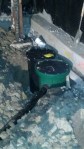
- Catch Basin containers for the sewage ejector pump and the sump pump (the lowest point of our plumbing system).
-

- Cast Iron underground plumbing being installed
-

- Plumbing Contractors digging the piping trench
-

- Future Shower drain area, boxed in to prevent from concrete covering the drain
-
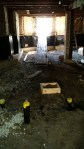
- Future plumbing stack
-
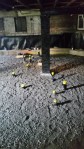
- Plumbing inspection passed! Pipe buried with soil
-

- Compacting and leveling the basement dirt
 IT STARTED ON SAWYER